
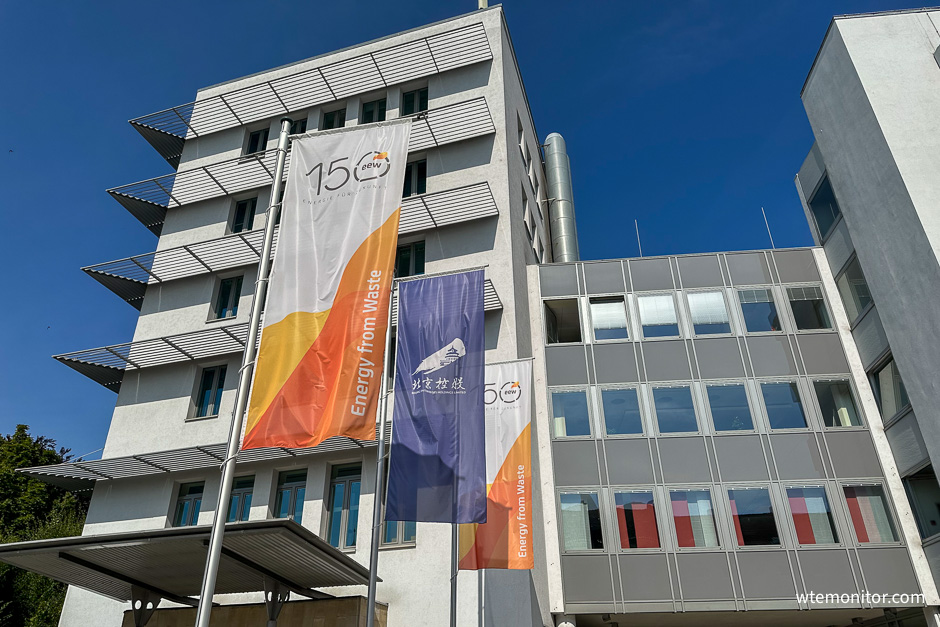
EEW’s 2025 sustainability report details the thermal treatment of more than 5.1 million tonnes of waste. A new reporting standard, however, makes direct comparisons to previous years challenging.
Key Takeaways
- EEW’s 2025 sustainability report indicates the processing of over 5.1 million tonnes of waste, but new reporting standards hinder comparisons with previous years.
- The European Sustainability Reporting Standards (ESRS) have changed data collection methods, establishing 2025 as a new baseline for comparisons.
- CO2 emissions reporting has shifted; gross Scope 1 emissions for 2025 are 2,197,181 tonnes CO2e, but previous year comparisons are unavailable.
- Despite a slight decline in energy utilisation rate to 41.6%, EEW aims for a 10% increase by 2027 through various efficiency measures.
- Water consumption decreased by 1.7%, linked to improved efficiency measures and optimised plant operations.
In 2025, plant operator EEW accepted and processed a total of 5,132,679 tonnes of waste for #thermal treatment#, according to its latest sustainability report. The total input consisted of 3,107,868 tonnes of municipal waste, 1,685,485 tonnes of commercial and industrial waste. It also included 339,327 tonnes of sewage sludge.
A direct comparison of the total volume with figures from 2024 is not provided in the report. The company has designated 2025 as a new baseline year following the implementation of a new reporting standard.
New Reporting Standard Prevents Direct Comparison
The introduction of the European Sustainability Reporting Standards (ESRS) has led to fundamental changes in data collection methodologies and accounting boundaries. Consequently, figures from 2025 onwards are not directly comparable with those from previous years. The report indicates that the processed quantities remain at a high level. This underscores the company’s role in waste management security.
The continued high demand for thermal waste treatment is attributed to regulatory requirements, such as landfill bans for certain waste fractions in Germany. Additionally, the company’s function as a critical infrastructure provider supports this demand. Investments in plant capacity and efficiency measures also contribute. As a result, large waste volumes continue to be processed.
Looking ahead, the expansion of pre-sorting activities, such as plastics pre-sorting in the Netherlands, could alter the composition of the input material in the medium term. However, this did not have a significant impact on the total quantity recorded for 2025.
ESRS Changes Reporting About Carbon Dioxide
The introduction of the European Sustainability Reporting Standards (ESRS) in 2025 has led to a fundamental change in the reporting of carbon dioxide (CO2) emissions by EEW. According to the company’s sustainability report, this new methodology and the expanded accounting boundaries mean that the figures for 2025 are not directly comparable with those of previous years. The year 2025 has been established as a new baseline for future comparisons.
For 2025, the report indicates gross Scope 1 emissions, which are direct emissions, of 2,197,181 tonnes of CO2 equivalent (CO2e). A corresponding value for 2024 is not provided in the new report. However, according to the old calculation method, EEW had emitted a total of 2,061,207 tonnes of CO2 equivalents in 2024.
Increase In Scope 2 Emissions Attributed To Expanded Reporting Boundaries
The report does provide comparative figures for Scope 2 emissions, which are indirect emissions from purchased energy. Market-based Scope 2 emissions increased from 14,521 tonnes of CO2e in 2024 to 18,503 tonnes in 2025, representing a rise of 27.4 per cent. This increase is attributed to the expansion of the reporting boundaries under the new ESRS framework. It is not a result of a change in operational performance.
For other emission categories, figures are only available for the new baseline year. Scope 3 emissions, which cover other indirect emissions in the value chain, were reported at 321,666 tonnes of CO2e for 2025. Total greenhouse gas emissions, both location- and market-based, amounted to 2,537,350 tonnes of CO2e. Additionally, biogenic emissions from the stationary combustion of waste were 2,480,496 tonnes of CO2e.
Energy Utilisation Rate Shows Slight Decline
In terms of energy efficiency, EEW’s sustainability report for 2025 shows a slight decrease in the energy utilisation rate compared to the previous year. The rate, which serves as the key performance indicator for energy efficiency, fell by 1.3 percentage points from 42.9 per cent in 2024 to 41.6 per cent in 2025.
The report does not provide a specific reason for this slight decline. However, it occurs in the context of the transition to the new European Sustainability Reporting Standards (ESRS) and potential methodological adjustments.
Target Set To Increase Efficiency By 10 Per Cent
Despite the decrease, the company has set a target to increase the energy utilisation rate by 10 per cent by the end of 2027, using the 2024 figure as the baseline. This would correspond to a target value of approximately 47.2 per cent.
To achieve this goal, EEW plans to implement several measures. These include the modernisation and efficiency enhancement of flue gas cleaning systems, the integration of battery storage, and an increase in the use of waste heat. For example, this can be done through the deployment of large-scale heat pumps. Further measures involve the expansion and optimisation of heat extraction at selected locations. Other efficiency improvements in plant operations are also planned.
Water Consumption Shows Slight Decline
EEW recorded a total water consumption of 1,642,079 cubic metres. This represents a decrease of approximately 1.7 per cent from the 1,670,000 cubic metres reported for 2024.
The reported consumption figure includes drinking water as well as water from wells, surface waters, and precipitation that is partially circulated within the facilities. The company notes that while 2025 is a new baseline year due to the adoption of new reporting standards, the figures for water consumption have been directly compared.
Efficiency Measures Drive Reduction In Water Usage
The reduction in water usage is linked to various efficiency measures and an optimised approach to plant operations. The continuous optimisation of the water balance remains a stated goal for the EEW Group.
Specific actions taken to reduce consumption include the optimisation of water circulation systems within the plants, the increased use of process and rainwater where feasible, and improved monitoring and control of water usage.
Leave a Reply