
Rising CO2 costs threaten Dutch Waste-to-Energy carbon capture plans — could this stall the Netherlands’ climate ambitions?

Key Takeaways
- Dutch WtE CO2 levy rises from €87.90/t (2025) to €103.66 (2026) and €303.55 by 2030, unlike other industries.
- Waste-to-Energy plants face a 100% emissions-cut target, above industry’s 43%, plus a €567m sector tax decided in April 2025.
- VA warns rising costs threaten carbon capture and the Aramis CO2 storage project, now unlikely before 2031.
- Bottom ash sales have stalled; from 2028 only washing will be allowed, needing new investment.
- Revised EU rules (May 2026) may restrict sludge exports and squeeze capacity.
The Dutch waste management association Vereniging Afvalbedrijven (VA) has warned that a sharply rising national CO2 levy on waste-to-energy plants is undermining investment in carbon capture and other decarbonisation projects. According to VA’s latest annual report, industrial installations pay €87.90 per tonne of CO2 in 2025. While most industrial installations will pay less from 2026 onwards, the levy for Waste-to-Energy plants, known in the Netherlands as afvalenergiecentrales (AECs), is set to rise instead. It will reach €103.66 per tonne in 2026 and €303.55 per tonne by 2030.
The increase comes alongside tougher emissions-reduction targets. Dutch industry as a whole must cut emissions by 43 per cent, but AECs were set an 80 per cent reduction target in 2024. Later, this target was raised to 100 per cent in the government’s 2025 Spring Memorandum. The VA lobbied the Tweede Kamer, the Dutch House of Representatives, to oppose the increase. Moreover, it briefed MPs on its consequences during 2025.
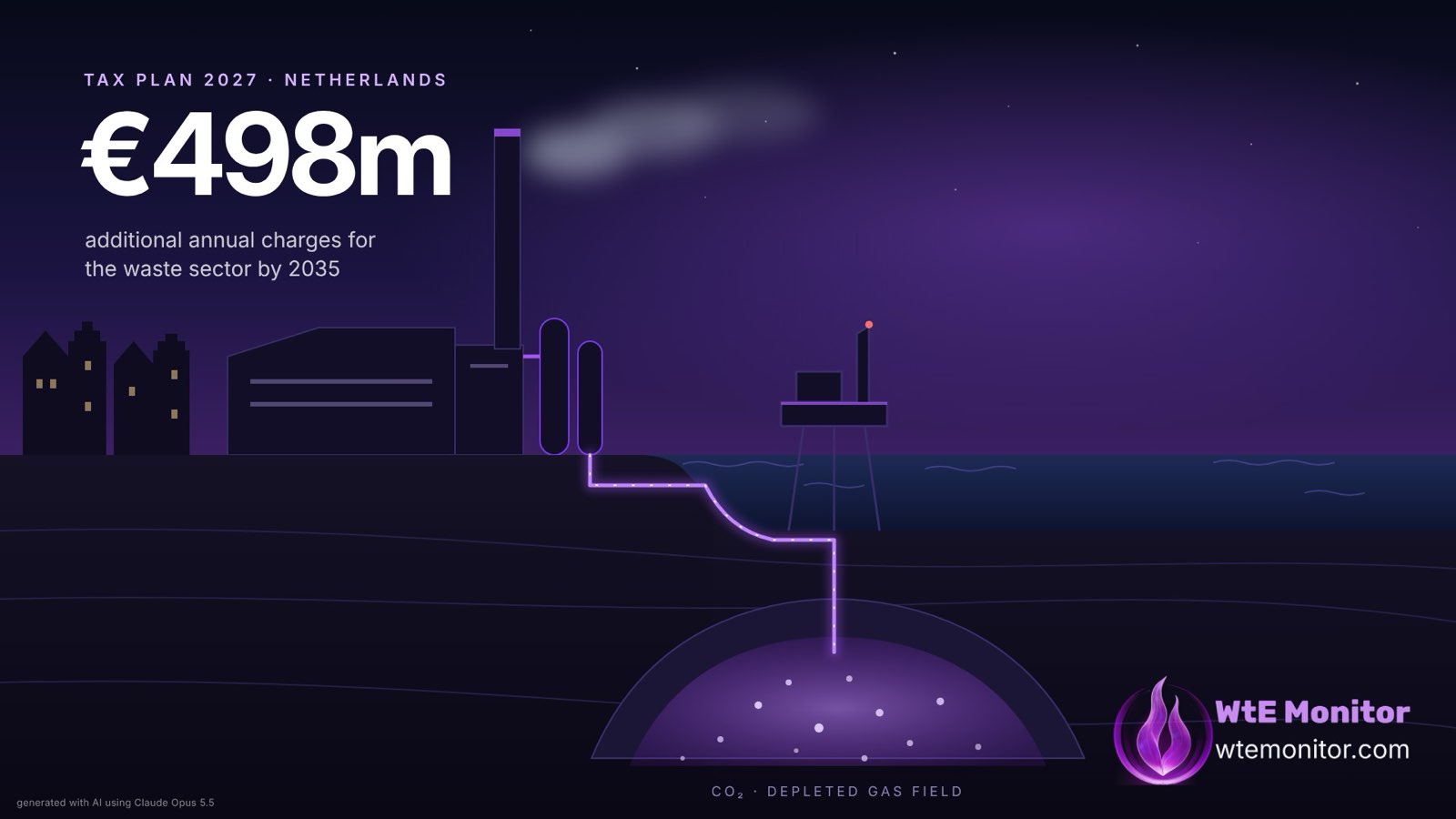
The levy comes on top of a separate national tax of €567 million on the waste sector, decided by the cabinet in April 2025 and to be collected via higher waste and CO2 taxes from 2027. The VA states that the combined burden is halting investment in circularity and carbon capture. It describes the situation as a missed opportunity for the country’s climate targets.
Carbon Capture and the Aramis Project
As of early 2025, Dutch WtE plants together operate around 208,000 tonnes of CO2 capture capacity per year, spread across several plants. All Waste-to-Energy plants have further capture projects in development. The VA states that rising costs are putting these plans at risk. This trend undermines an earlier sector ambition to capture two million tonnes of CO2 annually.
Also under pressure is Aramis, a large-scale project to transport and store CO2 in depleted North Sea gas fields, for which AECs are considered essential to reach the required start volume. In June 2025, the responsible minister indicated that the investment decision was under pressure and that delay was likely. As a result, the VA states that Aramis will not become operational before 2031.
Uncertainty over carbon capture investment is also affecting greenhouse horticulture, which draws CO2, mostly of biogenic origin, from waste companies to reduce natural gas use; three-quarters of the CO2 used in Dutch greenhouses currently still comes from fossil sources. A report by CE Delft, produced with input from the VA and its members, warns of a looming structural shortage of sustainable CO2 for greenhouses. It cites investment uncertainty and unresolved questions over the so-called bioswap mechanism, whose potential abolition would make CO2 storage more financially attractive than reuse.
Heat Networks and Bottom Ash
Waste-to-Energy plants are also expanding heat deliveries to district heating networks. Under the Dutch Climate Agreement, half a million additional existing buildings are to be connected to heat networks before 2030. A new Wet collectieve warmte (Collective Heat Act) takes effect in January 2026. The VA supports faster rollout of heat networks and describes Waste-to-Energy plants as an important source of sustainable heat. However, it has raised concerns with the Ministry of Climate and Green Growth over the proposed method for calculating the sustainability of that heat.
Sales of bottom ash, the residue left after incinerating residual waste, have stalled, largely due to public concern following discoveries of batteries in applications using the material. Under the new Circulair Materialenplan, which has taken effect at the end of 2025, only washing will be permitted as a bottom-ash processing method from 2028 onwards. Around 40 per cent of bottom ash is currently washed, and existing capacity is insufficient to process all the ash produced. As a solution, the VA has proposed a new Green Deal with the government to fund additional washing capacity. This builds on an earlier 2012–2020 agreement on the sustainable use of incineration bottom ash (IBA).
Cross-Border Rules and EU Emissions Trading
The Netherlands exports most of its flammable hazardous waste and sewage sludge for incineration abroad, owing to a shortage of domestic processing capacity. A revised EU Waste Shipment Regulation (EVOA), taking effect in May 2026, will tighten import and export requirements and allow receiving countries to refuse shipments. The VA warns that foreign incineration plants may not meet the new criteria for “useful application,” which could block further export of sewage sludge. Consequently, it has called on the Dutch government to agree safeguards with other countries. Dutch Waste-to-Energy plants also incinerate residual streams from foreign recycling companies. The VA expects the €567 million national tax to increase waste exports and reduce domestic production of secondary materials.
A separate VA working group, formed with sludge processors SNB, GMB and EEW, is addressing the national tax, the revised EVOA and concerns over future sludge-processing capacity.
A Declining but Essential Sector
According to VA figures, the volume of waste incinerated in the Netherlands fell from 7.572 million tonnes in 2020 to 6.422 million tonnes in 2024. The waste sector accounts for around 8 per cent of Dutch sustainable energy production, or 6 per cent when measured specifically as “energy from waste,” according to the report.
Yves Luca, chairman of the VA’s Energy from Waste division, said: “Our sector has a strong track record on sustainability and remains fully committed to meeting the agreed climate targets. A stable, level playing field at both national and European level is essential if we are to keep investing in future-proof solutions. That would allow the sector, among other things, to lay an important foundation for the Aramis CO2 storage project.”
Read More
Ask WtE Monitor
Answers come only from WtE Monitor articles and plant data, with sources. Ask in any language.
Your question is processed by Anthropic to generate the answer. Please do not enter personal data. Privacy policy
3 questions a month with a free subscription, unlimited with WtE Monitor+. Subscribe free · Get WtE Monitor+

Leave a Reply