
A new 38-country report suggests that putting a carbon price on Waste-to-Energy could have an unintended effect on landfill. Which countries are most at risk – and what should policymakers do?

Key Takeaways
- RDFIG’s 38-country report finds landfill taxes in 24 countries (€11–154/t), incineration taxes in only 13 (€8–98/t).
- Diverging national taxes distort competition and push waste-derived fuel across borders.
- A €110/t ETS stress test shows landfill could be taxed less than incineration in over ten countries.
- Cyprus, Italy, Malta and Romania face the greatest risk of diversion to landfill.
- RDFIG urges ETS as the main EfW carbon price and keeping landfill less attractive than recovery.
Europe’s fragmented waste taxes risk undermining efforts to reduce landfill, strengthen recycling and improve energy security, the RDF Industry Group (RDFIG) has warned in a new report. The pan-European trade association, which represents producers, transporters and recoverers of refuse-derived fuel (RDF) and solid recovered fuel (SRF), is calling on European and national policymakers to align landfill and Energy-from-Waste (EfW) taxation so that treatment decisions reflect capacity, efficiency and environmental performance rather than differences in national tax burdens.
The report “The Uneven Playing Field: How Europe’s Waste Taxes Distort Recovery, Landfill and Trade” maps landfill taxes and restrictions alongside incineration taxes across 38 European countries. For 2026, it identifies landfill taxes in 24 of the 38 countries (63 per cent), with rates ranging from approximately 11 to 154 euros per tonne. Only three countries exceed 100 euros per tonne: the United Kingdom (154 euros), Belgium (141 euros) and Latvia (130 euros). No national landfill tax was identified in 14 countries, among them Germany, Luxembourg, Norway and Switzerland, several of which rely on regulatory restrictions on landfilling untreated or combustible waste rather than on fiscal deterrence.

Incineration Taxed in 13 of 38 Countries
Incineration taxation is identified in 13 countries (34 per cent), with combined tax burdens ranging from 8 to approximately 98 euros per tonne. Eight countries apply a tonnage-based tax, six a carbon-based tax, and Denmark additionally an energy-based tax. Denmark and the Netherlands apply several forms of incineration tax to the same facilities.
On the report’s combined measure, Denmark carries the highest burden at 98 euros per tonne, followed by the Netherlands (47 euros), Norway (45 euros) and Sweden (38 euros). Germany’s national emissions trading system equates to 24 euros per tonne. Carbon pricing for EfW already takes several forms: Denmark, Lithuania and Sweden have included EfW in the EU ETS, Germany applies national emissions trading, Norway uses a CO2-based incineration duty with an ETS exemption, and the Netherlands combines a tonnage-based with a carbon-based tax.
As approaches diverge, the report argues, comparable recovery facilities become more or less competitive because of their location. Where incineration taxes are applied inconsistently, they risk providing an artificial incentive for waste-derived fuel to move between countries simply to avoid taxes. At the same time, additional taxation of recovery without sufficient landfill deterrence risks pushing fiscal incentives against the waste hierarchy.

Robert Corijn, Chair of the RDF Industry Group’s Policy Working Group, said: “Europe wants to reduce landfill, recover resources and strengthen its energy security. Those ambitions depend on making better use of the infrastructure we already have, across national borders. Waste should move because a facility offers suitable capacity, efficient energy recovery or access to decarbonisation infrastructure. National tax differences should not determine which facilities can compete.”
Stress Test With a Carbon Price of 110 Euros
The report includes a full-exposure ETS stress test, applying an assumed carbon price of 110 euros per tonne of CO2 alongside expected 2030 national taxes. According to RDFIG, this is not a forecast of 2030 treatment costs, but tests what happens to the relative fiscal signal between landfill and energy recovery if the full carbon cost is applied without corresponding reforms elsewhere.
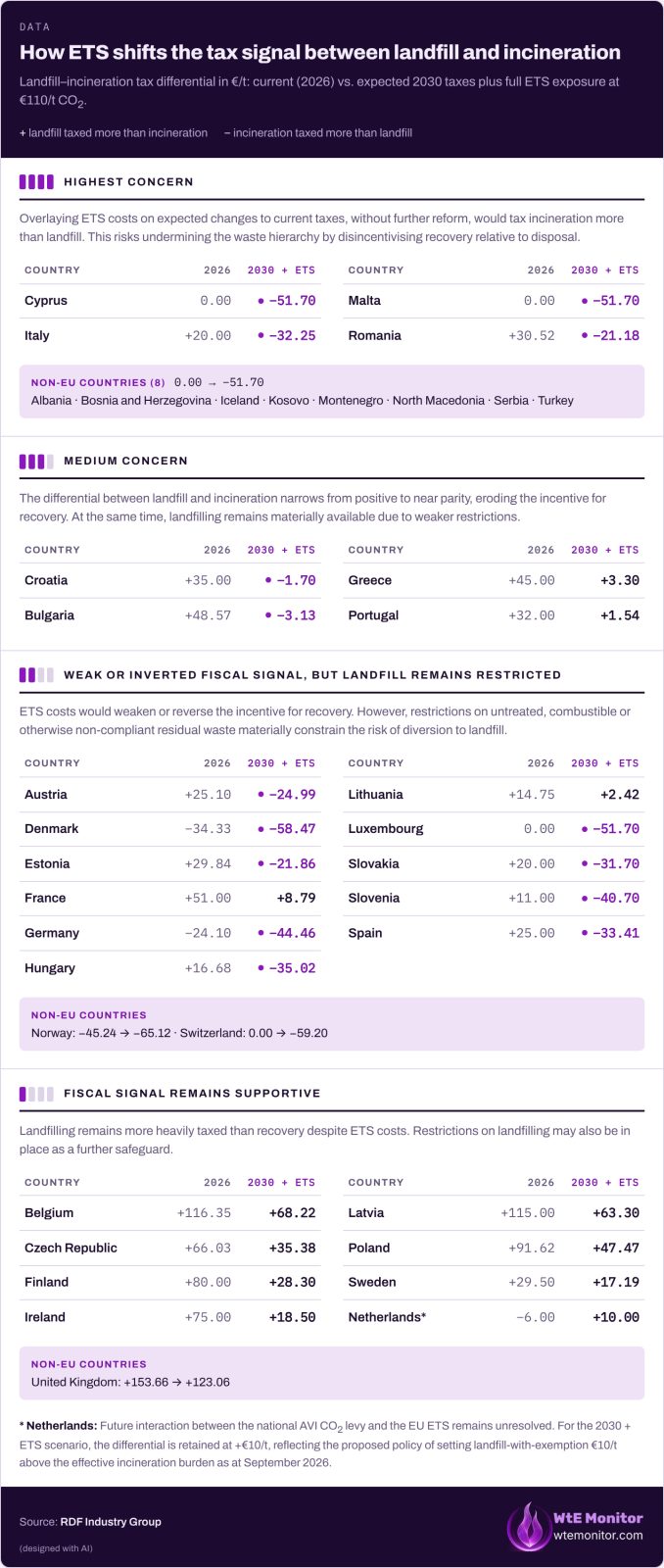
The results show how far that signal could shift. In Italy, the modelled landfill–incineration tax differential moves from +20 euros per tonne in 2026 to –32.25 euros per tonne under the scenario. Romania moves from +30.52 to –21.18 euros per tonne, Spain from +25 to –33.41 euros per tonne. In Cyprus and Malta, which currently tax neither landfill nor incineration, the differential falls from zero to –51.70 euros per tonne. Elsewhere, the margin favouring recovery narrows sharply: from +32 to +1.54 euros per tonne in Portugal, from +45 to +3.30 euros per tonne in Greece, and from +51 to +8.79 euros per tonne in France. Without wider reform, the Group concludes, ETS could leave landfill taxed more leniently than incineration in more than ten countries, with the differential narrowing towards parity in others.
The risk is greatest, the report finds, where higher carbon costs on EfW coincide with substantial landfill availability and weak fiscal or regulatory restrictions. It places Cyprus, Italy, Malta and Romania in this group. In a second group, including Austria, Denmark, France, Germany and Spain, the fiscal signal would also weaken or reverse, but restrictions on landfilling untreated or combustible waste constrain the risk of diversion to landfill. For Germany, the report puts the differential at –24.10 euros per tonne today and –44.46 euros per tonne under the scenario.
In a third group, including Belgium, the Czech Republic, Finland, Ireland, Latvia, Poland and Sweden, landfill remains more heavily taxed than recovery despite ETS costs. RDFIG states that this broadly reflects the European Commission’s own analysis, which recognises that extending carbon pricing to incineration can create competitive distortions with landfill where taxes, restrictions or bans do not already make landfill sufficiently unattractive.
Data
How ETS shifts the tax signal between landfill and incineration
Landfill–incineration tax differential in €/t: current (2026) vs. expected 2030 taxes plus full ETS exposure at €110/t CO2.
+ landfill taxed more than incineration− incineration taxed more than landfill
Highest concern
Overlaying ETS costs on expected changes to current taxes, without further reform, would tax incineration more than landfill. This risks undermining the waste hierarchy by disincentivising recovery relative to disposal.
| Country | 2026 | 2030 + ETS |
|---|---|---|
| Cyprus | 0.00 | −51.70 |
| Italy | +20.00 | −32.25 |
| Country | 2026 | 2030 + ETS |
|---|---|---|
| Malta | 0.00 | −51.70 |
| Romania | +30.52 | −21.18 |
Non-EU countries (8) 0.00 → −51.70
Albania · Bosnia and Herzegovina · Iceland · Kosovo · Montenegro · North Macedonia · Serbia · Turkey
Medium concern
The differential between landfill and incineration narrows from positive to near parity, eroding the incentive for recovery. At the same time, landfilling remains materially available due to weaker restrictions.
| Country | 2026 | 2030 + ETS |
|---|---|---|
| Croatia | +35.00 | −1.70 |
| Bulgaria | +48.57 | −3.13 |
| Country | 2026 | 2030 + ETS |
|---|---|---|
| Greece | +45.00 | +3.30 |
| Portugal | +32.00 | +1.54 |
Weak or inverted fiscal signal, but landfill remains restricted
ETS costs would weaken or reverse the incentive for recovery. However, restrictions on untreated, combustible or otherwise non-compliant residual waste materially constrain the risk of diversion to landfill.
| Country | 2026 | 2030 + ETS |
|---|---|---|
| Austria | +25.10 | −24.99 |
| Denmark | −34.33 | −58.47 |
| Estonia | +29.84 | −21.86 |
| France | +51.00 | +8.79 |
| Germany | −24.10 | −44.46 |
| Hungary | +16.68 | −35.02 |
| Country | 2026 | 2030 + ETS |
|---|---|---|
| Lithuania | +14.75 | +2.42 |
| Luxembourg | 0.00 | −51.70 |
| Slovakia | +20.00 | −31.70 |
| Slovenia | +11.00 | −40.70 |
| Spain | +25.00 | −33.41 |
Non-EU countries
Norway: −45.24 → −65.12 · Switzerland: 0.00 → −59.20
Fiscal signal remains supportive
Landfilling remains more heavily taxed than recovery despite ETS costs. Restrictions on landfilling may also be in place as a further safeguard.
| Country | 2026 | 2030 + ETS |
|---|---|---|
| Belgium | +116.35 | +68.22 |
| Czech Republic | +66.03 | +35.38 |
| Finland | +80.00 | +28.30 |
| Ireland | +75.00 | +18.50 |
| Country | 2026 | 2030 + ETS |
|---|---|---|
| Latvia | +115.00 | +63.30 |
| Poland | +91.62 | +47.47 |
| Sweden | +29.50 | +17.19 |
| Netherlands* | −6.00 | +10.00 |
Non-EU countries
United Kingdom: +153.66 → +123.06
* Netherlands: Future interaction between the national AVI CO2 levy and the EU ETS remains unresolved. For the 2030 + ETS scenario, the differential is retained at +€10/t, reflecting the proposed policy of setting landfill-with-exemption €10/t above the effective incineration burden as at September 2026.
Source: RDF Industry Group(designed with AI)

Consequences for Recycled Materials
The implications extend beyond EfW. Sorting and recycling processes produce residues that require treatment, and higher taxes on those residues increase the cost of producing recycled materials. This, the report argues, could weaken their competitiveness against virgin alternatives and work against Europe’s circular economy objectives.
The Group also calls for recovery capacity to be considered collectively across Europe, rather than assuming every country must build sufficient facilities to treat all of its own residual waste. Cross-border recovery can connect countries with limited treatment options to existing capacity elsewhere, including facilities supplying district heat or developing carbon capture and storage. At the same time, the report finds that several countries continue to landfill more than half of their municipal waste despite having landfill taxes. Effective diversion therefore requires sufficient tax signals alongside enforcement, separate collection, sorting, recycling and access to recovery capacity.
Andy Jones, Chair of the RDF Industry Group, said: “Europe has spent decades building a waste hierarchy designed to deliver better environmental outcomes. As carbon pricing expands and fiscal frameworks evolve, we must ensure that taxation supports that hierarchy rather than undermines it.”
Six Recommendations to Policymakers
RDFIG is calling on policymakers to:
- keep landfill less attractive than recovery for suitable residual waste, through effective restrictions or sufficient landfill taxation,
- align national fiscal frameworks and recovery-capacity planning, allowing Europe to make better use of existing infrastructure,
- make ETS the principal carbon-pricing mechanism for EfW, phasing out or redesigning additional EfW-specific taxes, with 2036 providing a point of convergence under the current EU proposal,
- standardise how ETS costs are measured, allocated and passed through, so that suppliers understand their charges and benefit from reducing fossil-carbon content,
- protect the competitiveness of recycled materials, accounting for the tax burden of treating recycling residues,
- support practical emissions reductions and investment through better sorting, fossil-carbon reduction, heat recovery and CCS.
The findings were previewed at RWM/ESS Expo and will be presented at the RDF Conference in London on 26 November 2026.
Read More
Ask WtE Monitor
Answers come only from WtE Monitor articles and plant data, with sources. Ask in any language.
Your question is processed by Anthropic to generate the answer. Please do not enter personal data. Privacy policy
3 questions a month with a free subscription, unlimited with WtE Monitor+. Subscribe free · Get WtE Monitor+
Leave a Reply