
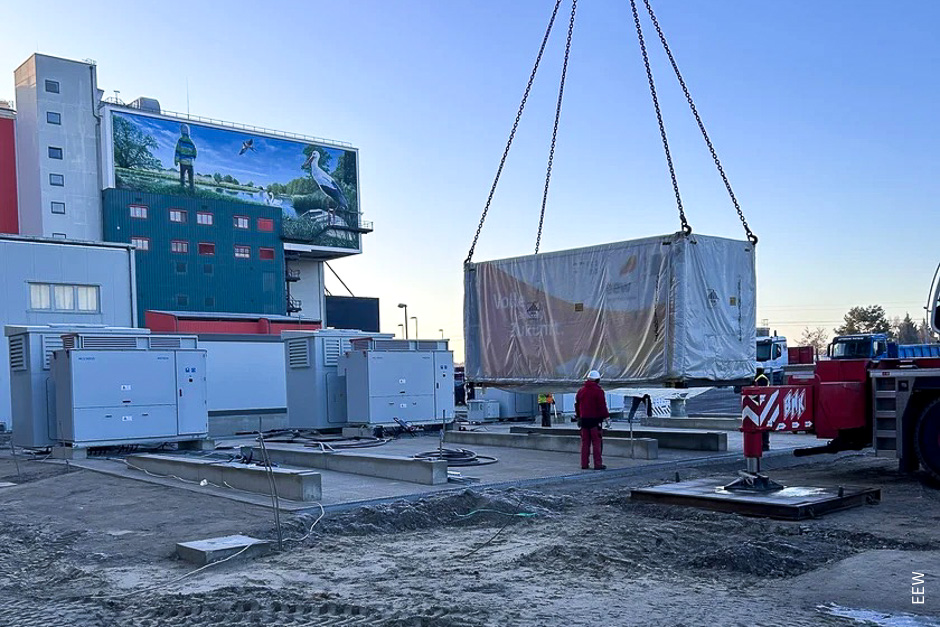
A new battery storage facility at the EEW-site in Premnitz has reached its final milestone before commissioning. The new storage facility is changing how energy from waste is fed into the grid.
Key Takeaways
- The EEW Battery Storage Premnitz facility has reached its final milestone with the delivery of three battery storage containers, enhancing energy management.
- The installation of medium-voltage switchgear, inverters, and transformers is complete, paving the way for commissioning.
- This battery storage helps stabilise the power grid by storing excess energy and feeding it back when needed, especially during peak demand.
- EEW combines waste recycling with energy storage, producing electricity and district heating for thousands of households in Premnitz.
- This innovative model serves as a blueprint for other sites in Germany, showcasing the integration of battery storage with thermal waste treatment.
With the delivery of three battery storage containers, each weighing 44 tonnes, at the end of November, the EEW Group’s first battery storage facility at the Premnitz site has reached the last major milestone before commissioning. The modules can store up to 15 megawatt hours of energy and form the heart of the new storage facility, which EEW is implementing together with Tricera.
Installation reaches final milestone
The medium-voltage switchgear weighing around 38 tonnes, which connects the storage technology to the public power grid, had already been installed in mid-November. The inverters and transformers have also already been installed.
“Today’s step marks the final major milestone before commissioning,” says EEW project manager Christian Schüttenhelm. He explains that the battery storage system will not only make the Premnitz plant more flexible, but also more future-proof, and that EEW is specifically developing the power plants into grid-supporting storage power plants, thereby making an active contribution to the energy transition.
Battery storage stabilises the power grid
In future, the battery storage system will temporarily store energy when there is a surplus of electricity in the grid. If necessary, the stored energy can be fed back into the grid when it is needed, for example to stabilise the grid frequency or to meet peak demand.
Battery storage facilities of this size are capable of compensating for short-term fluctuations in the power grid and contribute to security of supply, especially in a volatile energy market with a growing share of renewable energies.
Premnitz combines waste recycling and storage technology
With the integration of storage technology at the Premnitz site, EEW is further expanding the site’s role as an energy supplier. Premnitz produces electricity for more than 40,000 households from waste energy, supplies the industrial park with process steam and generates district heating for Premnitz and the city of Brandenburg an der Havel.
In future, this energy will no longer be provided solely as base load, but will be fed into the grid flexibly and according to demand.
“Premnitz combines tradition with the future,” says Klaus Piefke, Technical Director of EEW Premnitz. He emphasises that EEW is the first in Germany to use battery storage technology in combination with a thermal waste treatment plant and that this model can serve as an example for other sites.




Leave a Reply