
The ITAD warns that the EU Emissions Trading System could make waste incineration even more expensive than landfilling – which would turn the waste hierarchy on its head. Here are the improvements the association is calling for.

Key Takeaways
- ITAD welcomes the EU ETS reform proposal but warns it must not make incineration pricier than landfilling.
- Waste incinerators have little control over the waste they receive, unlike conventional fuel users.
- Landfilling faces only monitoring duties initially, leaving competitive distortion risks unresolved.
- Germany could qualify for an opt-out until 2035 if two of three EU criteria are met.
- The monitoring regulation must reflect BEHG experience and the sector’s specific needs.
The German Association of Thermal Waste Treatment Plants (ITAD) has responded to the European Commission’s proposal to reform the EU Emissions Trading System (EU ETS 1). Several concerns raised by the industry for years have been taken up in the proposal, the association said in a press release. At the same time, considerable need for clarification remains.
The proposal shows that the sector’s particular technical, organisational and waste management conditions must be given greater consideration, ITAD said.
The Cost Gap in Favour of Landfilling Must Not Widen
In ITAD’s view, a CO2 price on thermal waste treatment must not widen the cost gap in favour of landfilling. As long as untreated municipal waste continues to be landfilled across large parts of the EU, this risk remains. Direct pricing of emissions from landfills is not yet in sight.
The association regards it as a positive signal that the Commission has recognised the risk of shifts running counter to the waste hierarchy. Landfilling is therefore to be included as a new activity in Annex I of the EU ETS Directive. However, initially there will only be monitoring, reporting and verification obligations. From ITAD’s perspective, numerous questions remain unresolved here. Therefore, a significant risk of competitive distortion persists.
Waste Is Not A Freely Chosen Fuel
ITAD stresses that waste cannot be compared with other fossil fuels and that waste treatment is not a conventional production process. Operators have little influence over the volume and composition of the waste delivered. So the scope for operational emission reductions is correspondingly limited. This fact is not sufficiently taken into account in the proposal put forward.
In Germany, waste must be thermally treated as part of public services of general interest. Additionally, this is required for environmental protection reasons, the association said.
ITAD welcomes the fact that heat supplied by thermal waste treatment plants to district heating networks is, in principle, still to be eligible for free allowance allocations beyond 2030. This acknowledges the plants’ importance. For example, they are important for municipal heat planning.
Opt-Out Until 2035 For Germany to Be Examined
The Commission proposes exempting municipal waste incineration plants from the obligation to surrender allowances until 2035. However, at least two of three criteria must be met: a national CO2 tax of a comparable level, achievement of European recycling targets, and achievement of the landfilling target.
ITAD views this proposal as recognition of the differing development of waste management across Europe. States with efficient recycling infrastructure and a very low landfilling rate must not be treated the same as member states that continue to landfill large quantities of untreated municipal waste. Germany could meet the waste management targets and would thus be a candidate for the opt-out. However, according to ITAD, several legal, economic and political questions must be clarified before a final assessment can be made.
Monitoring Regulation Must Take National Experience Into Account
From ITAD’s perspective, the design of the Monitoring Regulation (MVO) is of particular importance. It will govern the procedure for reporting and monitoring obligations. Only if the specific features of the waste management sector are taken into account can a valid system be established.
Experience from Germany’s national emissions trading scheme (BEHG) as well as the sector’s technical challenges must be reflected in the MVO. The association cites the fee and pricing framework needed to allow plant operators to pass on allowance costs to those responsible with legal certainty. In addition, there must be uniform requirements for quantifying the CO2 emissions subject to allowance surrender.
“We welcome the fact that the European Commission is taking up key concerns of the waste management industry. Nevertheless, it must be stated that emissions trading in its classic form is fundamentally unsuited to municipal waste incineration,” said ITAD Managing Director Bastian Wens. “Waste is not a conventional fuel, and its safe treatment is part of public services of general interest. Inclusion would only be acceptable if the framework conditions for the sector were adapted, including avoiding competitive distortions and shifts towards landfilling, and promoting investment in carbon management solutions. We will engage constructively to ensure emissions from municipal waste incineration are handled appropriately,” Wens added.
Background: The Reform of Emissions Trading
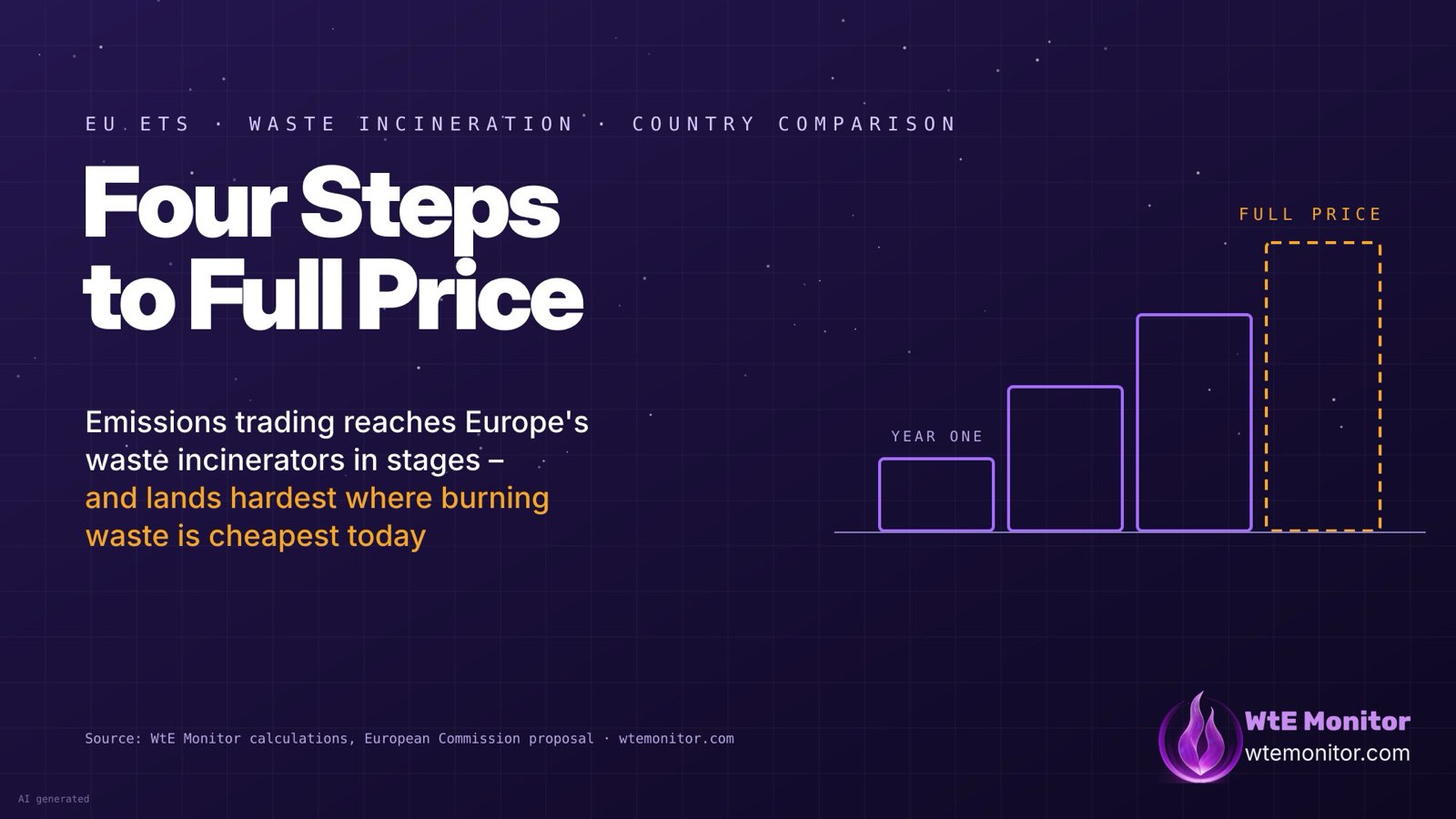
The European Commission published a proposal to amend the EU Emissions Trading System (EU ETS 1) on 17 July. Under the proposal, municipal waste incineration plants are to be gradually brought into the scope of allowance surrender under EU ETS 1 from 2031. This will include annual increases of 25 percent up to 2034.
The Commission puts the sector’s greenhouse gas emissions at around 40 million tonnes of CO2. ITAD member plants account for roughly a quarter of this. The Commission also notes that most member states currently have no targeted decarbonisation measures in place for this sector.
In Germany, some ITAD member plants have already been subject to EU ETS 1 for years. Meanwhile, the remainder have had to purchase allowances under the national emissions trading scheme (BEHG) since 2024. The climate reduction measures achieved so far in the German waste sector have come about through strict landfill regulations and advanced waste management practices. They did not come about through emissions trading systems.
Read More
Ask WtE Monitor
Answers come only from WtE Monitor articles and plant data, with sources. Ask in any language.
Your question is processed by Anthropic to generate the answer. Please do not enter personal data. Privacy policy
3 questions a month with a free subscription, unlimited with WtE Monitor+. Subscribe free · Get WtE Monitor+
Leave a Reply