
€200 million, 18 extra megawatts, and not a single additional bin of waste burnt. How Offenbach plans to heat 10,000 more homes — using heat it already had.

Key Takeaways
- EVO is investing around €200 million in modernising and expanding its Offenbach Waste-to-Energy plant, with construction starting in October.
- Usable heat output rises from 45 to 63 megawatts without burning extra waste — enough for about 10,000 three-person households.
- Turbine exhaust steam use and flue gas condensation deliver the additional 18 megawatts.
- A new energy centre in Nordend will use waste heat from a neighbouring data centre via a 10-megawatt heat pump.
- EVO will end coal use; a new transport pipeline is due in 2028.
Energieversorgung Offenbach (EVO) is investing around €200 million over the coming years in the modernisation and expansion of its Waste-to-Energy plant. It is one of the largest infrastructure projects in the company’s history. Construction is due to begin in October; preparatory work started this week.
The plant forms the centre of the heat supply for the city and district of Offenbach. The aim is to increase the use of waste heat from thermal waste treatment. Usable heat output is to rise from 45 to 63 megawatts without burning additional waste. The additional 18 megawatts correspond to the annual heat demand of about 10,000 three-person households. Two technologies make this possible: turbine exhaust steam use and flue gas condensation.
EVO already supplies around 40 per cent of Offenbach households with district heating, as well as parts of Heusenstamm, Dietzenbach and Neu-Isenburg.
Three Goals Behind the Investment
Felix Schwenke, Lord Mayor of Offenbach and deputy chairman of the EVO supervisory board, said the city has pursued a three-part strategy since the early 2020s, both politically and through its shareholding in EVO. First, more people should be able to receive district heating for ecological reasons if they want it. Second, prices for consumers should remain as stable as possible in the long term – into the second half of the 2030s – in the interest of affordable housing and ancillary costs, making district heating more competitive economically. Third, the region should become less dependent on international energy and raw material markets. “For this long-term goal we are investing massively now,” Schwenke said.
Such strategies are not decided on paper but through implementation, the Lord Mayor added. The improved use of waste heat, not only from data centres but also within the EVO Waste-to-Energy plant itself, contributes to all three goals: more waste heat becomes available, it is used more efficiently and therefore remains more stable in price, which over time also makes it cheaper than increasingly expensive fossil fuels, while reducing dependence on energy from conflict regions.
Schwenke referred to the Russian attack on Ukraine, the conflicts in the Middle East and the current dispute over the Strait of Hormuz. “With the EVO project, value creation remains here in our region. Our money does not flow into the coffers of dictators such as the mullahs or Putin. That is how sensible municipal and corporate policy works,” he said.
Heat Transition Beyond the City Boundary
Carsten Müller, First District Councillor of the district of Offenbach, emphasised the regional significance of the investment. “The heat transition does not end at the city limits of Offenbach. Many citizens in the district already benefit from EVO’s district heating today. That is why this project is of central importance for the entire region. It strengthens security of supply, reduces CO₂ emissions and shows how municipal companies take responsibility for the future.”
EVO has announced that it will stop using coal for heat generation. The combined heat and power plant on Nordring in Offenbach is to be decommissioned in the coming years.
“We are not simply building a new energy plant. We are now creating the basis for tens of thousands of people to be reliably supplied with heat in the coming decades,” said Christoph Meier, chairman of the EVO management board. “This project is a promise to the region. We are investing today with foresight and responsibility so that future generations also benefit from a secure energy supply.”
Compressors and Flue Gas Condensation
At the Waste-to-Energy plant, EVO plans to compress exhaust steam from the turbine and raise it to a temperature of more than 120 degrees Celsius in order to feed the district heating systems, according to Catharina Friedrich, technical director on the EVO management board.
The second project at the site is flue gas condensation. Residual heat is extracted from the flue gas, which is around 140 degrees Celsius, and used to provide district heating.
All documents have been placed on public display at the Darmstadt regional council, Friedrich said, and no objections were raised within the prescribed period. The general contractor for the turbine exhaust steam project was commissioned in May.
New Energy Centre to Use Data Centre Waste Heat
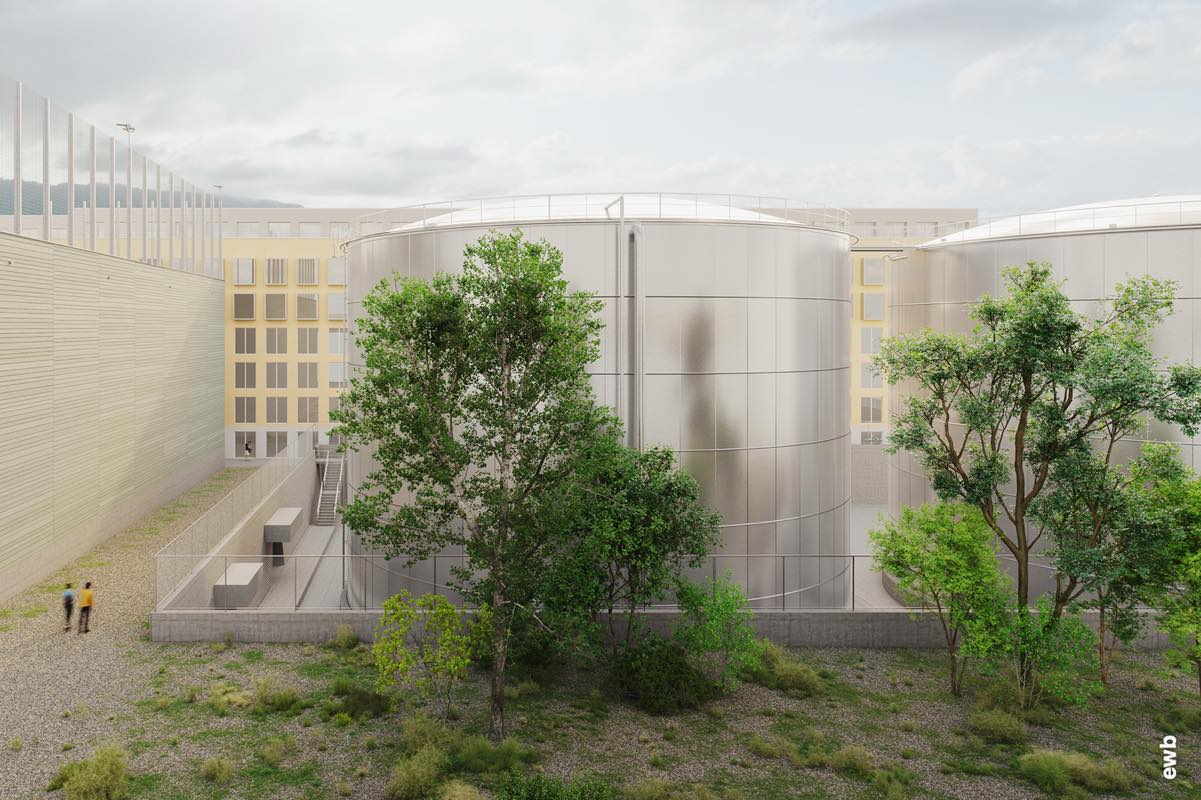
In parallel with the expansion of the Waste-to-Energy plant, EVO is building a new energy centre on the site of the former power plant in Offenbach’s Nordend district. A heat pump with a thermal output of at least ten megawatts will be installed there. For the first time, waste heat from a neighbouring data centre will be used. Computers in data centres generate large amounts of heat, but in many places this energy currently escapes unused into the environment. EVO intends to feed it into its network.
“No coal, no natural gas and no oil has to be burned for this heat,” Friedrich said. Two hot water generators with a combined output of 80 megawatts will also be added. The existing district heating network is being expanded and modernised at the same time.
“Our goal is to use every available kilowatt hour of energy intelligently,” Friedrich said. “We are recovering significantly more heat from existing processes without using additional resources. That makes our supply more sustainable and more independent.”
Transport Pipeline Due in 2028
EVO has been building a new district heating transport pipeline between the Waste-to-Energy plant and Offenbach since October 2025. Completion is scheduled for 2028. In recent years the company has also invested around €50 million in a new flue gas cleaning system and a modern sewage sludge treatment plant.
“The broad support from politics, administration and the public shows that we are working towards a common goal,” Meier said. “The heat transition is a task for generations. With these investments we are making it tangible in Offenbach and the district.”
Read More
Ask WtE Monitor
Answers come only from WtE Monitor articles and plant data, with sources. Ask in any language.
Your question is processed by Anthropic to generate the answer. Please do not enter personal data. Privacy policy
3 questions a month with a free subscription, unlimited with WtE Monitor+. Subscribe free · Get WtE Monitor+
Leave a Reply