
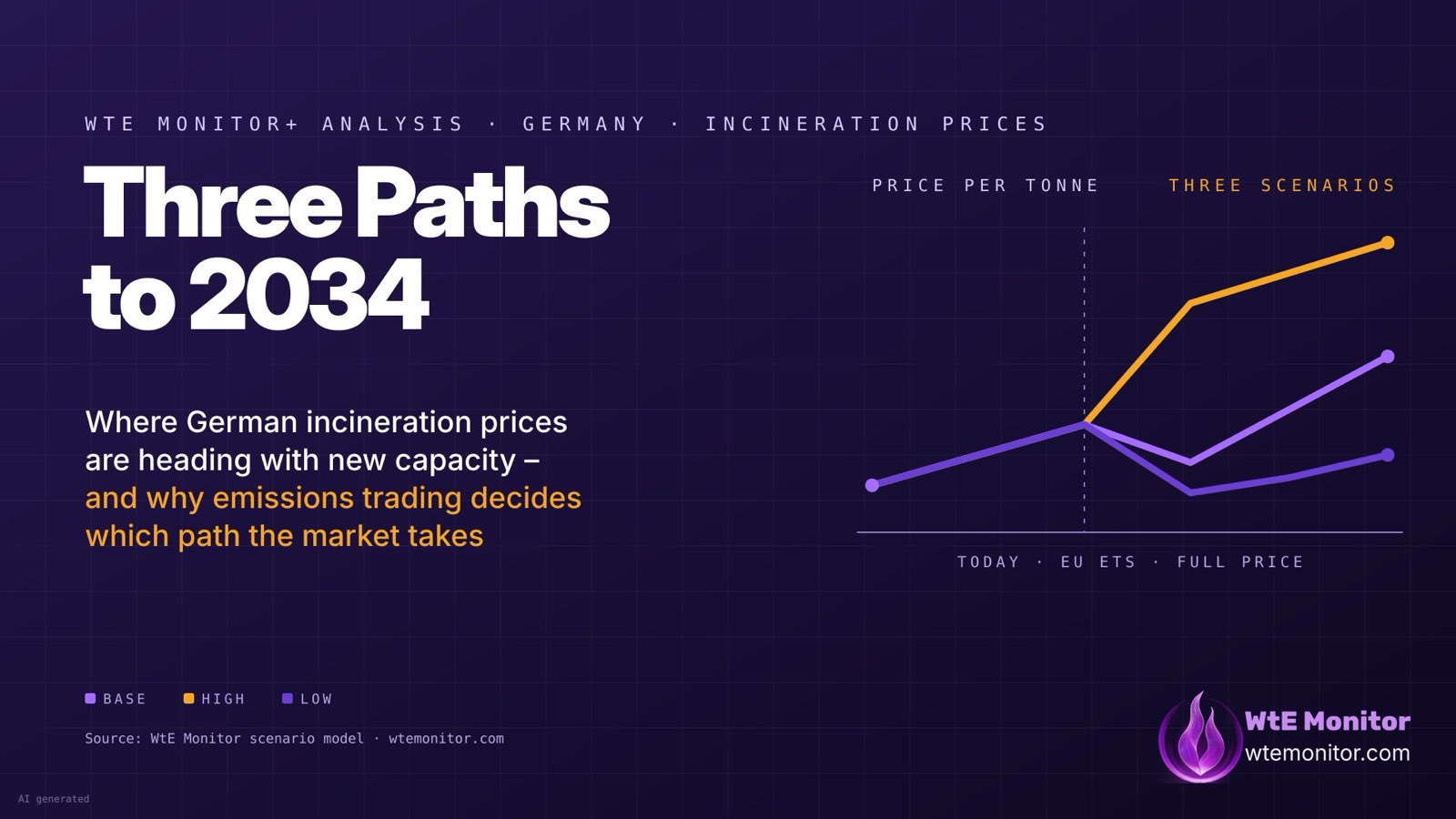
From €133 per tonne of municipal waste in 2026 to somewhere between €150 and €252 in 2034: a WtE Monitor scenario model shows how wide the range of possible incineration prices in Germany has become.

The 92 plants of Germany’s incinerator association ITAD burned 25.9 million tonnes of waste in 2024 and are close to full. New capacity of up to 1.9 million tonnes a year is in the pipeline to 2031. From 2031 the sector is to join the EU Emissions Trading System. Since 2024, operators have already paid a national carbon price. This adds around €26 to every tonne of residual waste in 2026 and is passed on in full.
Carbon Becomes the Main Driver
WtE Monitor has modelled prices for municipal waste, commercial waste under contract and the spot market in three scenarios. These scenarios differ in plant utilisation, the allowance price, and the method used to determine fossil emissions. In addition, they differ in energy revenues and the way Germany moves from its national scheme to the EU system.
Until 2030, all three paths point upwards or sideways. The carbon surcharge accounts for most of the increase in commercial waste prices once the national price is tied to the EU allowance market in 2028. Then the paths diverge. In two scenarios, the first year of the EU ETS brings a result that hardly anyone in the market expects. In the third, prices jump by more than €30 per tonne of municipal waste within a single year.
Which three decisions in Berlin and Brussels move the price by close to €90 per tonne, why new plants will not ease the market, and what this means for contracts that run beyond 2030: the WtE Monitor+ analysis has the details.
Read More
Ask WtE Monitor
Answers come only from WtE Monitor articles and plant data, with sources. Ask in any language.
Your question is processed by Anthropic to generate the answer. Please do not enter personal data. Privacy policy
3 questions a month with a free subscription, unlimited with WtE Monitor+. Subscribe free · Get WtE Monitor+

Leave a Reply